
A seller once called me in a panic three days after closing. She’d just learned a pipe had burst in the house she’d sold, and she wanted to know if she was still on the hook. She wasn’t, because the deed had already recorded. Had that pipe burst a week earlier, before closing, with her policy already cancelled, that call would’ve gone very differently. Timing is the whole ballgame here. The decision to cancel homeowners insurance lands at the very end of a sale, right when most people have already moved on in their heads.
Can You Cancel Homeowners Insurance Before Closing Day?
The short answer is that you technically can, but you shouldn’t. Cancellation is allowed at any time, and you’re owed a refund of unused premium when you do. Nothing legally stops you from calling your agent the morning after you sign a sales contract. Legality isn’t the issue. The trouble is what sits between contract and closing. Inspections and appraisals come first, then financing, repair talks and plain old delays.
The lender also has a say. Mortgage lenders require borrowers to keep homeowners insurance in force for as long as the loan exists. Cancel early and your servicer can put a force-placed policy on the house and bill you for it. Those cost more and cover less. You’d be paying extra for worse protection on a house you’re trying to hand off.
How long is that gap, realistically? Homes spent a median of 35 days on the market in October 2026, according to the National Association of REALTORS®. That’s up from 33 days in September and 34 days a year earlier. Add the escrow period and you’re looking at about two months between listing and funding. Anyone who decides to cancel homeowners insurance on the strength of an accepted offer is betting on roughly 30 to 45 more days of perfect luck.
Early last year I bought a house from a widow in Mesquite who’d been quietly carrying two mortgages for almost eleven months. She’d kept both policies active the whole time, and that cost her real money. Then a storm took shingles off the vacant house that spring, and her carrier paid. She told me she’d nearly dropped that policy twice.
Should You Cancel Homeowners Insurance or Transfer It to the Buyer?
A homeowners policy isn’t attached to the building. It’s a contract between you and your insurer, and it covers your financial interest in that building. Once the buyer owns the place, your interest ends and theirs begins. Coverage doesn’t cancel automatically when the mortgage pays off at closing, either. The policy just sits there, quietly billing you for a house that belongs to someone else.
Texas law doesn’t require this coverage at all. The requirement came from your loan, and the new owner will have to insure the house on their own.
Some carriers will let you move an existing policy to a new address rather than cancel it outright. It isn’t a transfer to the buyer. Your same policy follows you, and the premium gets recalculated for the new property’s rebuild cost, roof age and location risk. Buying another house in the same state with the same insurer? Ask about this before you cancel homeowners insurance on the old place. The paperwork is lighter, and you skip new-customer underwriting.
Find out what your current policy covers while the house sits empty between your move-out and the buyer’s move-in. Standard forms restrict coverage once a home has been vacant for 60 consecutive days, and some older forms use 30. Vandalism and glass breakage are the usual exclusions. A quick call to your agent about a vacancy endorsement costs nothing and takes ten minutes.
Does Your Mortgage Payoff Affect When You Cancel Homeowners Insurance?
Where does my escrow money go?
It’s the question I hear most, and the answer is cleaner than it sounds. When your sale pays off the loan in full, the servicer owes you whatever’s sitting in that escrow account. Federal rules under Regulation X give the servicer 20 days to return any remaining escrow balance after a borrower pays the loan in full. Saturdays, Sundays and legal public holidays don’t count toward that window. You can read the rule yourself on the CFPB’s regulation page. In calendar terms, plan on about a month.
Sellers trip up right here. They see the escrow money arrive and assume the insurance got handled. It didn’t. Cancelling the policy is still your job, handled directly with your carrier, and it’s separate from the escrow refund. I’ve watched sellers go four or five months paying premiums on a house they no longer own because nobody told them the two weren’t connected.
The payoff doesn’t end your need for coverage; the deed recording does. Sell a house you own free and clear and there’s no lender pressure at all. Your own judgment is the only thing keeping the policy active, and that cuts both ways. Nobody will force-place coverage on you, and nobody will remind you to cancel homeowners insurance either.
Check your payoff statement for the escrow line. Compare it to the check that shows up. If the numbers don’t match or nothing arrives within that federal window, write your servicer and reference the rule.
When Should You Cancel Homeowners Insurance After Selling Your House?
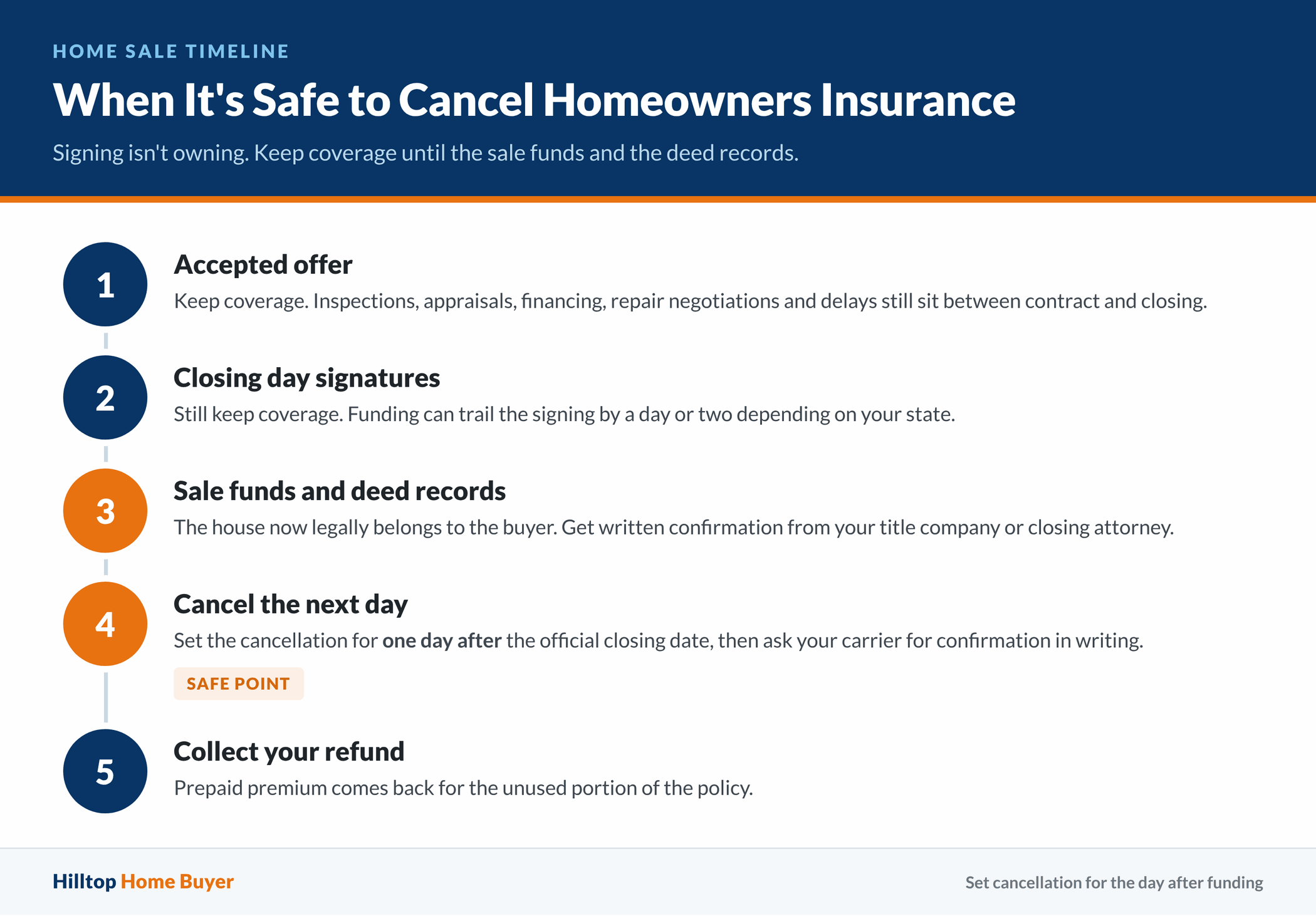
Monday morning brings the closing table, the signatures and the wire instructions. By Wednesday the funds are disbursed, the deed is recorded at the county, and the house legally belongs to someone else. That gap is why timing matters.
Set your cancellation date for the day after the sale funds and title transfers, not the day you sign. Signing isn’t owning, so a cancellation date one day past the official closing is the safe play. Some states close and fund a transaction the same day. In others, funding happens a day or two later, and dry-funding states add their own lag.
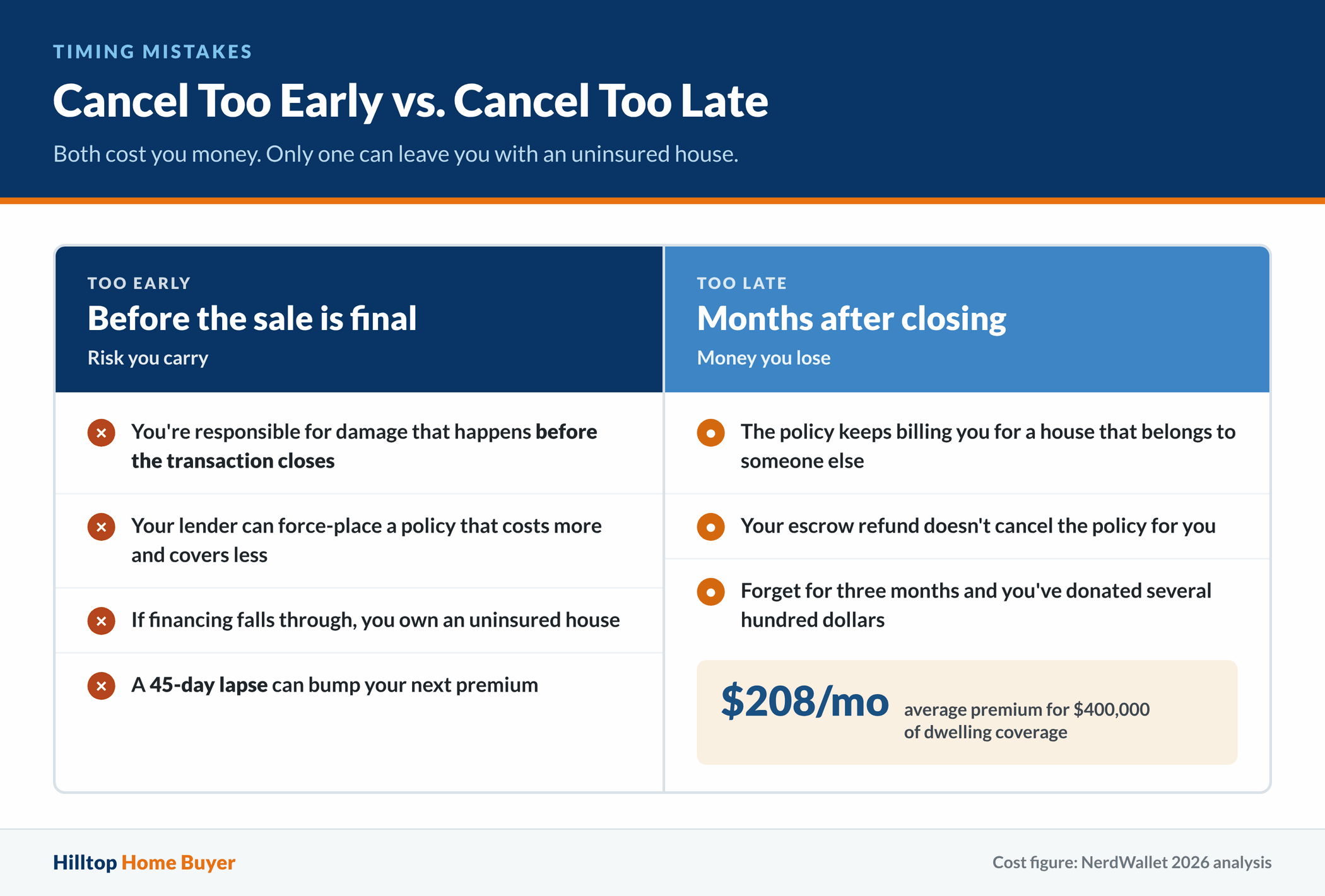
Sellers who cancel homeowners insurance too late lose real money to the overlap. NerdWallet’s 2026 figures put the national average at $2,490 a year for $400,000 of dwelling coverage, or roughly $208 a month. You can see how they got there in their rate breakdown. Forget for three months and you’ve donated several hundred dollars.
Moving swallows your attention, which is why this trips up so many sellers. You’re forwarding mail, switching utilities and enrolling kids in new schools. Your old insurance policy is the quietest item on a loud list, and the money keeps leaving your account regardless.
What Happens If You Cancel Homeowners Insurance Too Early?
Property damage is the obvious risk. Cancel coverage before the sale is final and you’re on the hook for any damage that happens before the transaction closes. Picture a buyer whose financing falls through. They walk away from a damaged house, and now you own an uninsured property with a hole in the roof and no claim to file.
Those failures happen more in a slow market, since buyers have options and less urgency.
And this market is slow. Existing-home sales dropped 5.5% month over month in October 2026 and 8.8% from a year earlier. The seasonally adjusted annual rate fell to 3.75 million, the lowest since August 2010, according to NAR’s newsroom page. When markets soften like this, escrows stretch out and buyers come back asking for lower prices. Keeping coverage through all of it is cheap protection against an expensive surprise.
Carriers also treat continuous coverage as a rating factor when you apply for a policy on your next home. A 45-day lapse can bump your new premium or push you out of a preferred tier.
Sellers in a tight spot sometimes want out faster than a traditional listing allows. A direct buyer like Hilltop Home Buyer can shorten the whole timeline. That also shortens the stretch you’re paying to insure a house you’ve already left.
What Documents Do You Need to Cancel Homeowners Insurance?
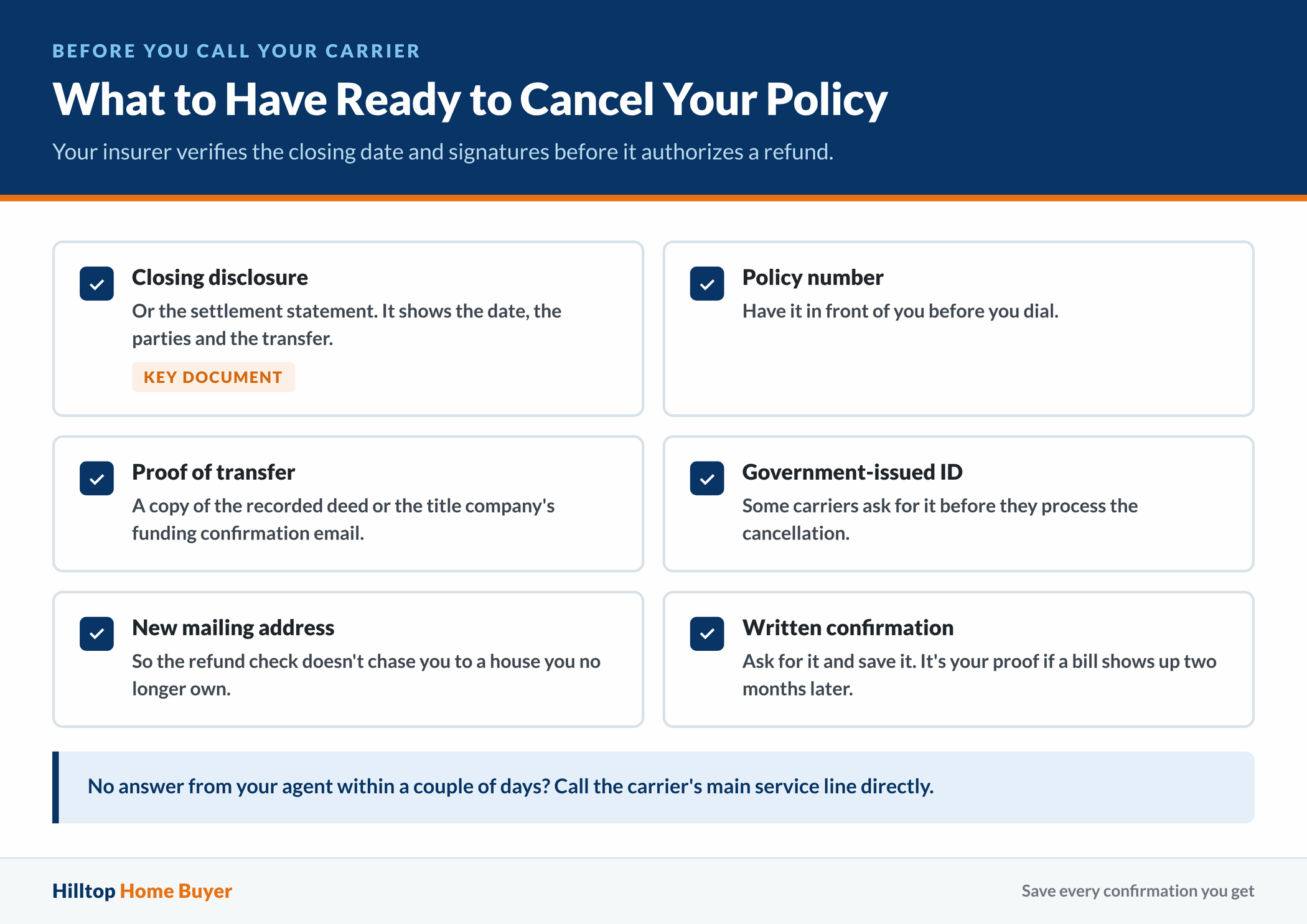
Before it approves a refund, your insurer will verify the official closing date and the signatures. Have the closing disclosure or settlement statement ready, since that one document shows the date, the parties and the transfer.
Pull together a few other items before you dial.
Your policy number comes first, obviously. Add a copy of the recorded deed if your title company sent one, or the title company’s funding confirmation email. Carriers sometimes ask for a government-issued ID. Give them your new mailing address too, or the refund check may chase you to a house you no longer own.
Most carriers accept email. Ask for a cancellation confirmation in writing and save it. That’s your proof if a billing statement shows up two months later.
A common slip is calling the agent who sold you the policy years ago, leaving a voicemail and calling it done. The agent may have retired, or the agency may have merged, and then nobody processes anything. Call the carrier’s main service line directly if your agent doesn’t confirm within a couple of days.
Will You Get a Refund When You Cancel Homeowners Insurance?
A seller I worked with paid her annual premium in full back in February and closed on the house in August. She figured that money was simply gone. About three weeks later a check arrived, and she was pleasantly surprised.
Prepaid premiums come back to you. Pay for a full year of coverage and your insurer refunds the unused portion on a prorated basis, so you only pay for the time you were covered.
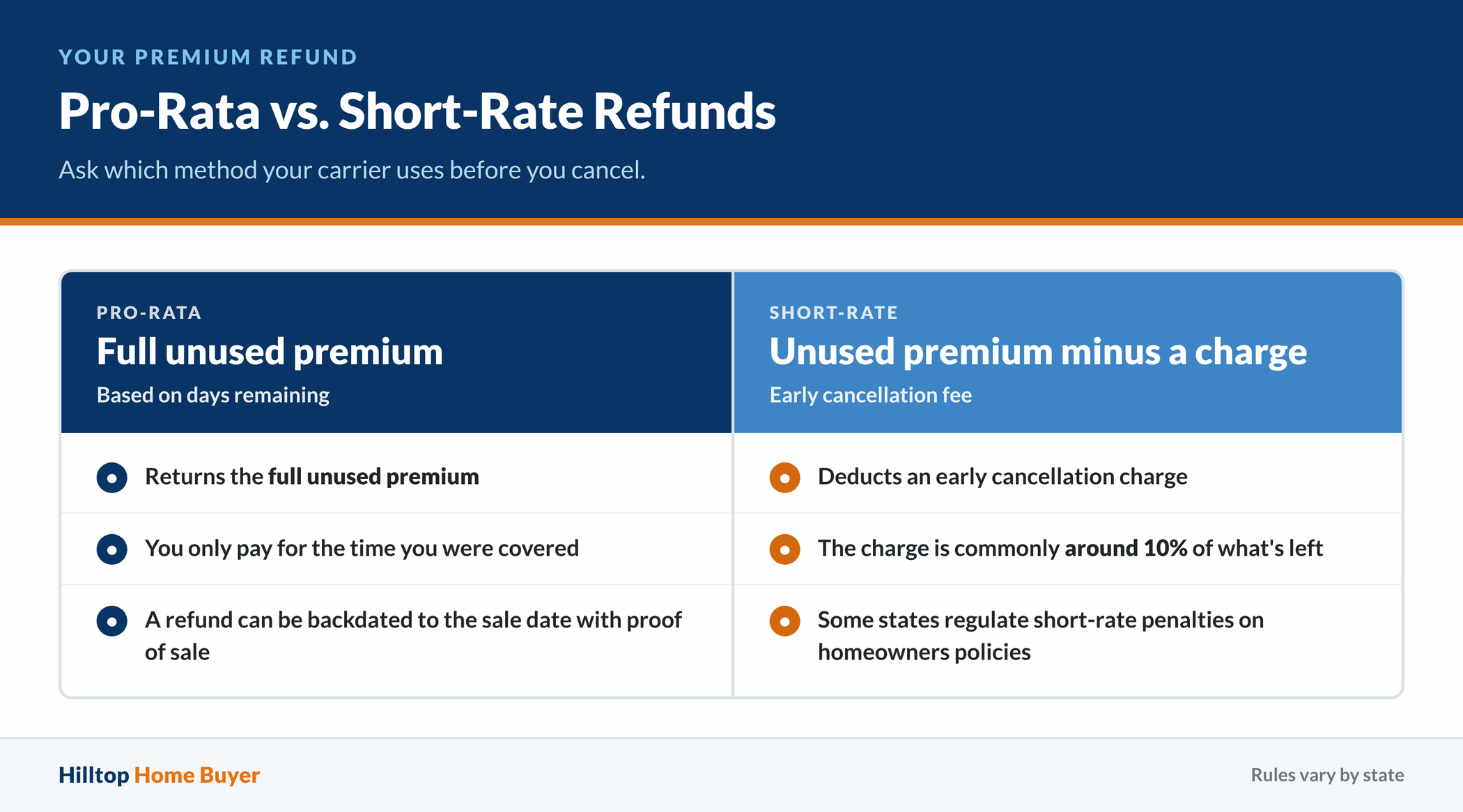
Not every refund is calculated the same way, though. A pro-rata refund returns the full unused premium based on days remaining. By contrast, a short-rate refund deducts an early cancellation charge, commonly around 10% of what’s left. Ask which method your carrier uses before you cancel homeowners insurance, because on a large annual premium the gap adds up. Your state may limit short-rate penalties on homeowners policies, and its insurance department can tell you what applies where you live.
Forgot to cancel for a few months? You can still cancel and generally get a refund backdated to the sale date, as long as you can show proof of the sale. Make the call even if it’s been a while. The longer you wait, the more paperwork they’ll want.
How Do You Cancel Homeowners Insurance Without a Gap in Coverage?
“If I’m moving into a rental for six months, why would I carry anything?”
My answer to that seller was simple. An unbroken coverage history is worth protecting if you plan to buy again.
Buying and selling on the same day takes a little coordination. Have the new policy start on the day you close on the new house, and set the old one to end the day after your sale funds. One or two days of overlap costs almost nothing. Even a short gap is the thing to avoid.
Moving in with family or traveling for a stretch? Ask your carrier about a named-insured or standalone liability policy, since several national insurers write these for people between homes.
If your sale is delayed, extend rather than cancel. When the closing date slips, keep the policy active and call your agent to update the timeline. Carriers handle this constantly and won’t penalize you for a postponed closing.
A man called me on a Thursday afternoon about a house he’d inherited in DeSoto. It had three bedrooms and a detached garage stacked floor to ceiling with his father’s woodworking tools and thirty years of magazines. His siblings lived out of state and wanted a clean exit with nothing to sort, so we bought it as it sat. The first thing I told him was to keep the estate’s coverage in place until we recorded. A vacant inherited property with no policy is one storm away from a mess nobody wants to inherit twice.
Frequently Asked Questions About When to Cancel Homeowners Insurance
When Is the Right Moment to End My House Insurance After a Sale?
Wait until the transaction has funded and the deed has been recorded with the county. Then set your cancellation for the following day. Signing closing documents doesn’t finish the job, because funding and recording can trail the signing by a day or more. Get written confirmation from your title company or closing attorney before you call your carrier.
What Does a Late Cancellation Cost on a $400,000 House?
Every month you wait to cancel costs another month of premium, billed at roughly the national average cited earlier in this article. Where the house is and how old the roof is will move your real number. So will your deductible and claims history. Homes in areas with heavy wind, hail or wildfire exposure cost far more to carry, so a slow cancellation stings more there. Pull your declarations page to see your monthly cost, then call your carrier the day after your sale funds.
What Should I Do with the Money My Insurer Sends Back?
Put it toward the first premium on your next home’s policy if you’re buying again, since that’s usually due at or before that closing. Renting for a while instead? It can cover a renters policy for a good stretch. Deposit it promptly either way. Some carriers void uncashed refund checks after a few months, and getting one reissued means another round of phone calls.
Do I Have to Cancel My Policy Myself When I Sell?
Yes, and nobody will do it for you. Your title company doesn’t notify your insurer, and neither does your lender. The policy won’t lapse on its own just because the mortgage got paid off. Call or write your carrier yourself with proof of the sale in hand, or you’ll keep paying premiums on a house with someone else’s name on the deed.
Can I Cancel Homeowners Insurance If My Buyer Takes Possession Before Closing?
Don’t. A pre-possession agreement lets a buyer move in early, yet you still own the property until the deed records. The liability is still yours. Talk to your agent about adding the buyer’s interest or adjusting the policy for the arrangement. Ask your closing attorney to spell out who carries what in writing.
What Dallas Sellers Should Know About Timing
If you’re selling in Dallas, plan on keeping your policy well after you accept an offer, and hold off until funding before you cancel homeowners insurance. Zillow’s home value index put the typical Dallas home at $302,485 through October 2026, down 1.2% from a year earlier. Homes there went to pending in a median of 38 days, and closing comes after that. Hilltop Home Buyer buys houses in Dallas and from homeowners across Texas who want a closing date they can plan around. Selling outside the city limits? The same timing applies when we buy houses in Mesquite. It holds for sellers looking for cash home buyers in DeSoto too.
Talk With Hilltop Home Buyer About Your Sale
Staring down a sale and trying to work out the timing on all of this? We’re happy to talk it through with you. Some folks just need a sounding board. Others want a closing date they can count on, so the insurance question has a clean answer. Either way, reach out to Hilltop Home Buyer whenever you’re ready. There’s no pressure, no obligation and no hard sell if you decide a traditional listing suits you better.
Not sure when your policy should end, or when to cancel homeowners insurance on the house you’re selling? We’ll walk you through a closing date that fits your move, so you know exactly when to call your carrier. Contact Hilltop Home Buyer with a few details about your house, or fill out the form below. There’s no cost and no obligation.
Helpful Texas Blog Articles
- Tenant Damage to Property in Texas
- How Long Does It Take to Sell a House in Texas
- How Do I Fire My Realtor?
- Is the Seller Responsible for Any Repairs After Closing?
- What Is the Minimum Estate Value for Probate on a Texas Home
- Texas Eviction Process Explained for Landlords and Tenants
- What to Ask a Realtor When Selling Your House
- Can You Sell Your House With a Quitclaim Deed in Texas
- When to Cancel Homeowners Insurance When Selling a House