
A buyer’s lender killed a sale I was watching in Garland over a single page filed back in the 1990s. Not a lien or back taxes, either. It was a quitclaim deed signed between two brothers, recorded and forgotten. Thirty years later it turned fatal when a title examiner pulled the chain. The homeowner had no idea that piece of paper was sitting there. If you’re holding property in Texas and a quitclaim deed is part of how you got it, you’ve got a solvable problem. Still, know what you’re working with before you call an agent.
What Is a Quitclaim Deed in Texas?
You might figure a deed is a deed, and any paper that records at the courthouse does the job. That assumption costs Texas homeowners real money. Quitclaims transfer whatever ownership interest the grantor happens to hold at that moment, and nothing more. Unlike a warranty deed, which conveys the property itself, it passes along only the grantor’s interest. It could be full ownership, or it could be nothing at all.
These documents get real suspicion in Texas. There’s no statutory quitclaim form in Texas; the legislature wrote a short statutory form only for warranty deeds. Courts here built a long line of cases holding that a quitclaim’s grantee doesn’t get bona fide purchaser protection. Buyers who take title through one are charged with notice of title defects, whether or not those defects show up in the public record.
Compare that to a general warranty deed, where the grantor backs up the title all the way through every prior owner. A special warranty deed narrows that promise to the grantor’s own period of ownership. There’s also the deed without warranty, which Texas recognizes, and that distinction matters more than the name suggests. Conveying the property is what a deed without warranty does, while a quitclaim conveys only the grantor’s claim. That difference is why Texas title companies will often insure the first and balk at the second.
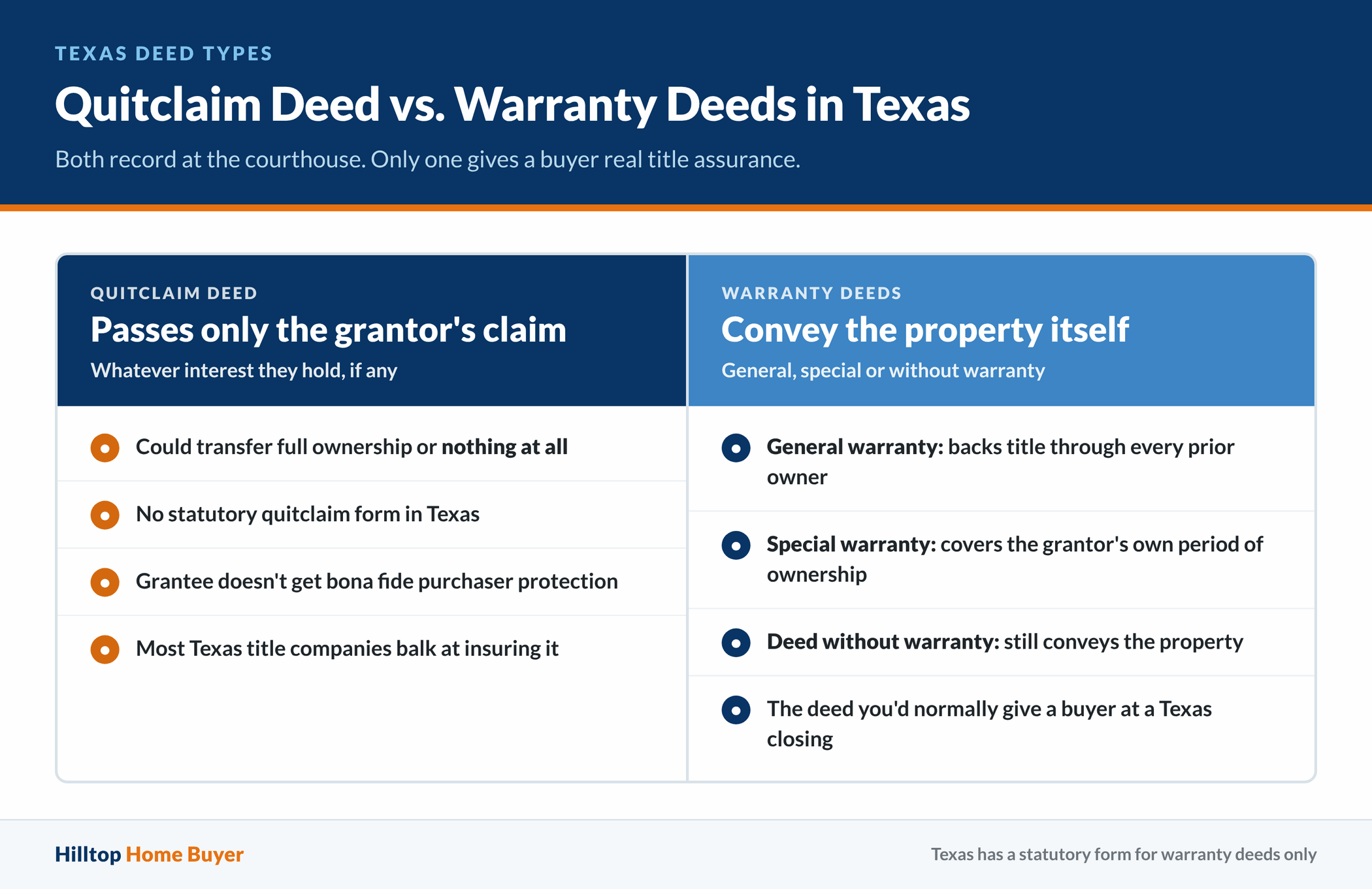
So yes, it’s legal here, and it records. It’s a real document with real effect between the two people who sign it. What it doesn’t do is give a future buyer, lender or title underwriter any reason to feel confident about who owns the house.
Who Typically Uses a Quitclaim Deed in Texas?
Picture us at your kitchen table with the coffee going cold. The people who use a quitclaim deed correctly in Texas almost never need it to survive a sale.
Divorce is the big one. One spouse signs off, the other keeps the house, and everybody moves on. Heirs sometimes use a quitclaim to consolidate fractional interests among siblings who inherited as tenants in common.
A while back, three siblings in Waxahachie called me about their mother’s house. The middle sibling had already signed a quitclaim deed to the other two, thinking that simplified things. It did, right up until a buyer’s title company asked why one heir had signed away an interest and the other two hadn’t signed anything.
Plenty of online advice calls a quitclaim deed the cheap, friendly way to move property between people who trust each other. The title company examining the file in four years has never met your family, and it decides whether the house closes. Divorce attorneys in Texas often steer clients away from quitclaim deeds for the marital home for exactly that reason. Title insurance companies may refuse to insure a title that passed through one, or they add extra exceptions and waiting periods.
Nothing about your loan changes, either. Your name comes off title but stays on the mortgage, because the lender isn’t a party to the deed. You’re still responsible for payments until the loan is refinanced, formally assumed or paid off. I’ve watched more than one divorced Texas homeowner discover that two years late, after the credit damage was already done.
How Do You Spot a Quitclaim Deed in Your Texas Title Chain?
For years I assumed the legal description was the easy part of these documents, and I was wrong. A bad description is one of the most common ways a quitclaim deed in your chain trips up a Texas sale. It’s the first thing I check.
Start with the deed that put the house in your name, then pull the one before it from the county clerk where the property sits. The grantor and grantee names should match the prior recorded instrument exactly. Next, check the legal description. Most Texas city homes use lot, block and subdivision, while rural acreage uses metes and bounds.
Look for the grantee’s mailing address on the face of the document, too. A deed without one costs a penalty fee of the greater of $25 or twice the recording fee to record. A gap like that can point to a deed nobody reviewed before filing.
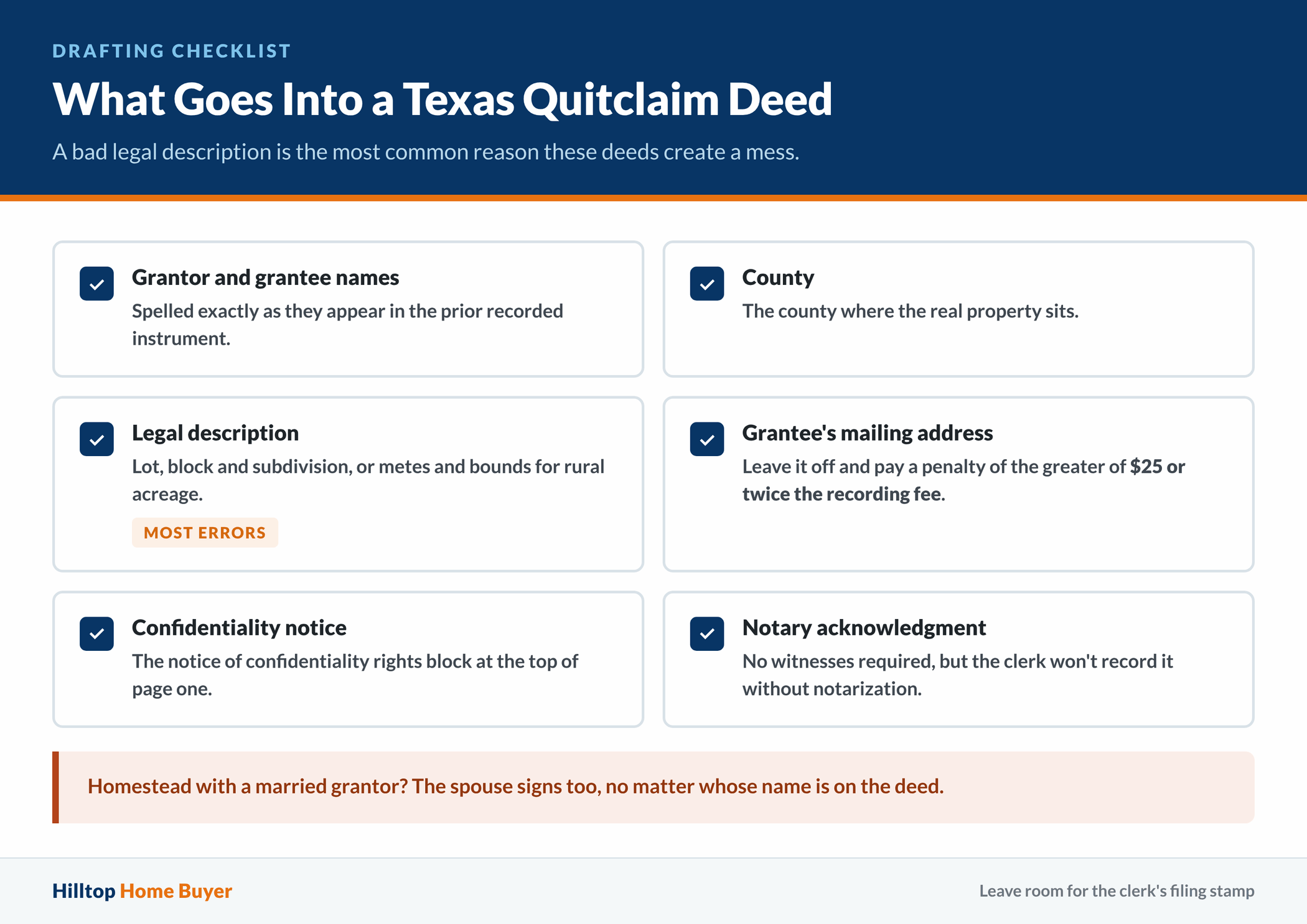
Then read the granting clause. Warranty deed language grants, sells and conveys. In a quitclaim, the clause only quits, or releases, whatever right, title and interest the grantor held. If your deed says “grant and convey,” you may not have a quitclaim deed at all, and that’s worth knowing before you list.
Take what you find to a title company before you sign a listing agreement. They’ll tell you whether the deed is really a quitclaim and what it’ll take to clear it before a buyer’s lender sees it.
How Do You Fill Out a Quitclaim Deed Correctly in Texas?
A widow in Pflugerville called me after downloading a form in MS Word, typing her late husband’s name in the grantor line and signing it herself. The property had never gone through probate, so his share wasn’t hers to sign away yet.
Every deed starts from one question, which is what interest the grantor holds right now, on paper, in the county records. Only what’s recorded counts.
Fill in the parties, the county, the legal description and the grantee’s address. No witness signatures are required in Texas, but the deed needs a notary’s acknowledgment (or a sworn witness proof) before it can be recorded. If the property is homestead and the grantor is married, the spouse signs too, regardless of whose name sits on the deed.
Acknowledgment is a condition of recording, not of validity between grantor and grantee. Without one of those, the county clerk won’t record the deed.
Should you hire a real estate lawyer for a document this short? For a correction between spouses on a paid-off house, probably not. Anything touching an estate, a lien, a mortgage or a future sale is different, and there the answer is yes. I say that as someone with no financial stake in you hiring an attorney. For a similar fee, a real estate lawyer or title company can usually draft a special warranty deed, and that document doesn’t carry a quitclaim’s baggage. I’ve seen that baggage sink sales that otherwise looked clean. My preference is a Texas attorney or title company preparing a special warranty deed from the start.
Recording and being useful are different things.
What Are Texas Rules for Recording a Quitclaim Deed?
You don’t send a deed to Austin. Texas has no state-level deed registry, so each of the 254 counties keeps its own records through its own clerk. You file in the county where the land sits, which may not be where you live. Under Texas Property Code section 11.001, the deed must be recorded in the county where part of the property is located. Recording in the wrong county has no effect. A private Texas quitclaim recording guide walks through the filing steps and points to the state’s county clerk directory.
Bring photo ID, since the clerk must see identification from whoever hands in a deed at the counter.
Fees run per page. Most Texas counties charge a modest fee for the first page plus $4 for each additional page, and your county clerk can confirm the current schedule before you drive downtown. Harris County, Bexar County and Travis County all publish their requirements online, and several accept electronic filing through approved submitters.
Turnaround depends on the clerk’s workload, and some counties move faster than others. Call ahead if you need the recorded copy back by a certain date.
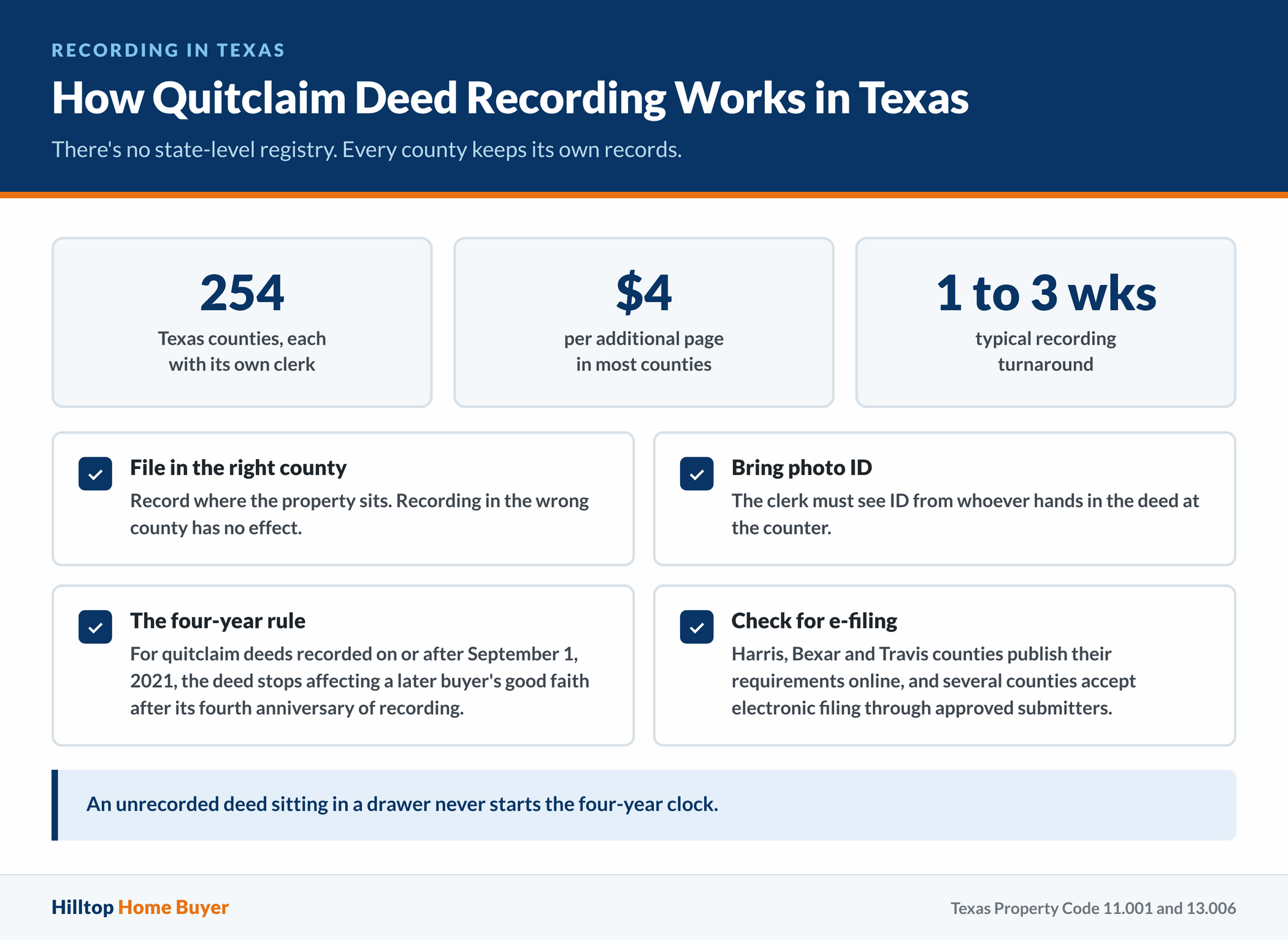
Texas Property Code § 13.006 says that after the fourth anniversary of recording, a quitclaim deed no longer affects the good faith of a later buyer or creditor. Only quitclaims recorded on or after September 1, 2021 get that treatment. That change fixed one old problem but didn’t cure defective deeds, liens, bad legal descriptions or homestead issues. Recording starts that clock, and a deed sitting unrecorded in a drawer starts nothing.
Can You Sell Your House with a Quitclaim Deed in Texas?
A quitclaim deed in your chain of title doesn’t make your house unsellable. It makes your house unfinanceable to most buyers, which feels identical from the driveway but isn’t the same problem.
Follow the chain from the buyer’s side. Their lender requires a title policy. Many Texas title insurance companies won’t insure a property with a quitclaim anywhere in its chain of title. Others will, but only with exceptions. No title insurance means no conventional, FHA or VA loan, and that entire pool of buyers disappears.
Who’s left? Cash buyers and investors who do their own title review and accept the risk.
The four-year rule above changes the math, depending on when your quitclaim hit the records. After four years, a qualifying quitclaim stops counting against the good faith of later buyers and lenders. Deeds recorded in 2019 are too early to qualify and still fall under the old rules. One recorded in the fall of 2021, by contrast, has already passed its fourth anniversary.
Selling as the grantor on a new quitclaim deed to your buyer is a separate and worse idea. Buyers in a normal sale expect marketable title, title insurance and lender acceptance, and a quitclaim delivers none of them.
In a normal Texas closing you’d convey a general or special warranty deed to your buyer, even with a quitclaim sitting upstream in your chain. That upstream deed still has to clear underwriting, and that’s usually where these sales come together or fall apart. Companies like Hilltop Home Buyer look at these chains regularly and can tell you quickly whether a title company will insure yours.
How Does Selling a Home with a Quitclaim Deed Work in Texas?
Curing the title before you list beats discovering the problem on day forty-two of your contract.
A title company will run the chain and tell you precisely what the objection is, because that’s their whole job on the transaction. Maybe the quitclaim deed is old enough to be cured by statute. Or it’s recent and sitting right in the middle of your ownership.
If the original grantor is alive and cooperative, the cleanest cure is asking them to sign a corrective instrument. The fix might be a correction deed, an affidavit, or a new warranty deed that gives proper title assurance. Underwriters are far more comfortable with a special warranty deed executed by the same person who signed the quitclaim years earlier.
Timing is where these plans slip. Texas is a buyer’s market right now, and the clock on a listing is longer than it was three years ago. Realtor.com data on the St. Louis Fed’s FRED site put the Texas median at 66 days on market in September 2026. Stack a sixty-day title cure on top of that and you’re carrying mortgage payments, insurance and lawn care on a house you’ve already sold in your head.
Zillow puts the Dallas median sale price at $433,000 for September 2026. Homes there went to pending in a median of 38 days. A rushed cash sale at a steep discount on a Dallas house with a fixable quitclaim problem is usually the wrong call.
Houston runs softer. The Houston Association of Realtors reported a median single-family price of $320,000 in October 2026, down 3% from a year earlier. In a market drifting down, a six-month title cure can cost you as much as the discount would have.
Run the numbers: carrying cost times months of delay, against the spread between a financed buyer and a cash buyer. Curing wins some of the time. Other times, selling to a buyer who accepts the title as-is is the better math.
Is a Quitclaim Deed the Right Choice for Your Texas Sale?
Austin’s median sold price fell 6.9% year over year in October 2026, to $404,802 across the metro, according to Unlock MLS. Homes there sold for an average of 92.2% of their list price. On a house worth that much, a title defect isn’t a paperwork annoyance. It’s six figures of equity parked behind a clerical problem. Owners there can see how we buy houses in Austin before they pick a path.
A quitclaim deed is the right instrument in Texas only when no money changes hands, no lender is involved and nobody plans to sell soon. Outside those conditions, use a deed without warranty or a special warranty deed, since title companies frequently require a proper deed anyway. Any knowledgeable buyer will take a deed without warranties over a quitclaim every time.
If a quitclaim already sits in your chain, you’ve got four realistic paths. You can cure it with a corrective instrument or wait out the statutory period if you’re close. Selling to a buyer who doesn’t need title insurance is the third. Clearing it through the courts is the last.
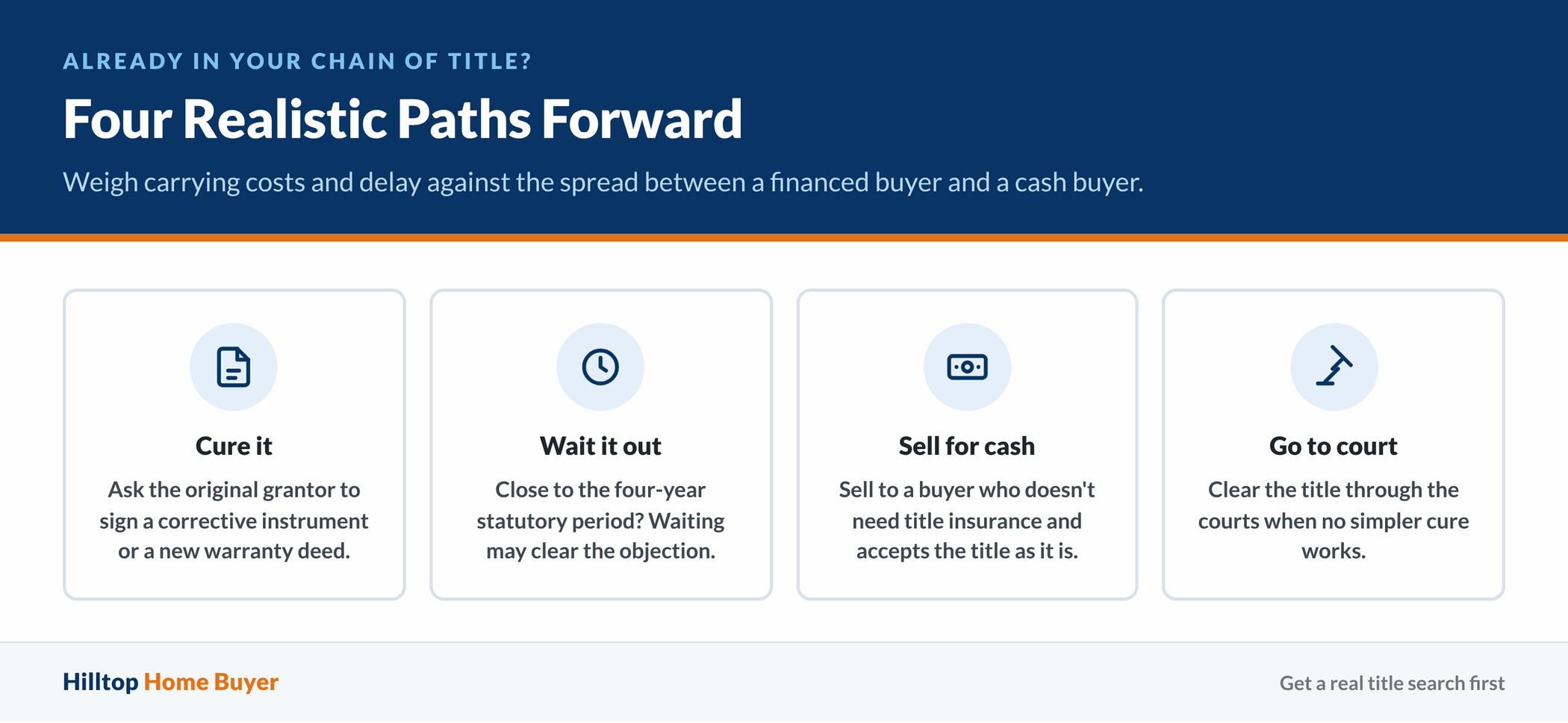
An heir up in Denton walked into exactly that fork last year. Her father’s house held thirty years of belongings. Neither of her siblings wanted a cleanout crew or a lawsuit. We’ve seen this setup go sideways plenty of times, so we bought it as-is with the title defect priced in. All three of them signed at the title company and were done.
Before you commit either direction, get a real title search and talk to someone who’s handled a Texas quitclaim deed before. Hilltop Home Buyer can usually tell you within a day whether yours is a two-week fix or a six-month one.
Frequently Asked Questions About Selling with a Quitclaim Deed in Texas
Can I Prepare My Own Quitclaim Deed in Texas?
Yes. You can draft and sign your own document in Texas, and plenty of people do it with a template and a notary appointment. The risk isn’t whether the clerk accepts it. What can hurt you is the legal description, the homestead signature rules and what the deed does to your ability to sell later. For anything beyond a simple correction on a house you own free and clear, having a real estate lawyer or title company draft it costs little and prevents a lot.
Is a Quitclaim Deed Legal to Use in Texas?
It is. Texas courts recognize a quitclaim deed as a valid transfer between the grantor and grantee, and county clerks record them every day. State law just doesn’t give the recipient the protections a warranty deed provides. So the document is legal and still a poor fit for most transactions involving money or financing.
What Are the Main Disadvantages of a Quitclaim Deed?
You get no warranty of title and no protection against liens or competing claims. Getting a Texas title company to insure the property afterward is hard, too. It also leaves the original borrower on the mortgage note, since a deed changes title and not debt. Together, those problems can make a house with a quitclaim deed hard to sell at full market value, even when nothing is wrong with the ownership.
Does Paying Off My Mortgage Clear a Quitclaim Deed From My Title?
No. Payoff gets you a release of lien from your lender, which gets recorded with the county clerk and clears the deed of trust off your title. Your chain of title doesn’t change. A quitclaim deed sitting upstream stays in the records, and a buyer’s title company will still examine it. Clearing it takes a corrective instrument, the four-year rule under § 13.006 if your deed qualifies, or a buyer who accepts the title as it is.
Will a Quitclaim Deed in My Chain of Title Stop a Cash Sale in Texas?
Usually not, because a cash buyer isn’t answering to an underwriter who demands an insurable title. Investors and direct buyers in Texas review the chain themselves and decide what they’re comfortable with. Many will close on a property a lender wouldn’t touch. You’ll typically see that reflected in the price, which is the tradeoff you’re weighing.
What Dallas Owners Should Weigh Before Picking a Path
Dallas sellers with a quitclaim deed in their chain face the same tradeoff between a title cure and a faster sale. Zillow data through September 2026 shows 68.7% of Dallas sales closed under list price. A cured title still helps, since it opens the door to buyers using a loan. If a long cure would cost more than it gains you, a direct sale may be the cleaner choice. The same math applies for owners talking with cash home buyers in Garland.
Get a Straight Answer About Your Title
Have a quitclaim deed in your chain of title and not sure where you stand? Send us a few details and we’ll tell you what we see, whether that’s a quick fix or a cash offer. Contact Hilltop Home Buyer or fill out the form below. There’s no cost and no obligation.
Helpful Texas Blog Articles
- Tenant Damage to Property in Texas
- How Long Does It Take to Sell a House in Texas
- How Do I Fire My Realtor?
- Is the Seller Responsible for Any Repairs After Closing?
- What Is the Minimum Estate Value for Probate on a Texas Home
- Texas Eviction Process Explained for Landlords and Tenants
- What to Ask a Realtor When Selling Your House
- Can You Sell Your House With a Quitclaim Deed in Texas
- When to Cancel Homeowners Insurance When Selling a House