
Four siblings, one house in Garland, and nobody can agree on a listing price. For me, that’s a Tuesday.
Co-owned property is everywhere in this state, and it rarely starts out complicated. A deed names two spouses. Parents add a child. Grandma dies and leaves the homestead to five kids who each got a sliver, so the paperwork multiplies quietly until someone needs money or wants out. When a house has multiple owners, a simple sale turns into a negotiation among people who may not have spoken in years.
Good news: Texas gives you more paths than you’d guess. I’ve spent years buying houses from families in exactly this spot, and almost every one of them closed. Let’s walk through how property ownership works here, what the law actually requires, and where multiple owners get stuck.
Who Are the Legal Owners When You Inherit Property in Texas?
Closing agents don’t care what the family agreed at the kitchen table. They care about recorded documents, and that’s where the trouble usually starts.
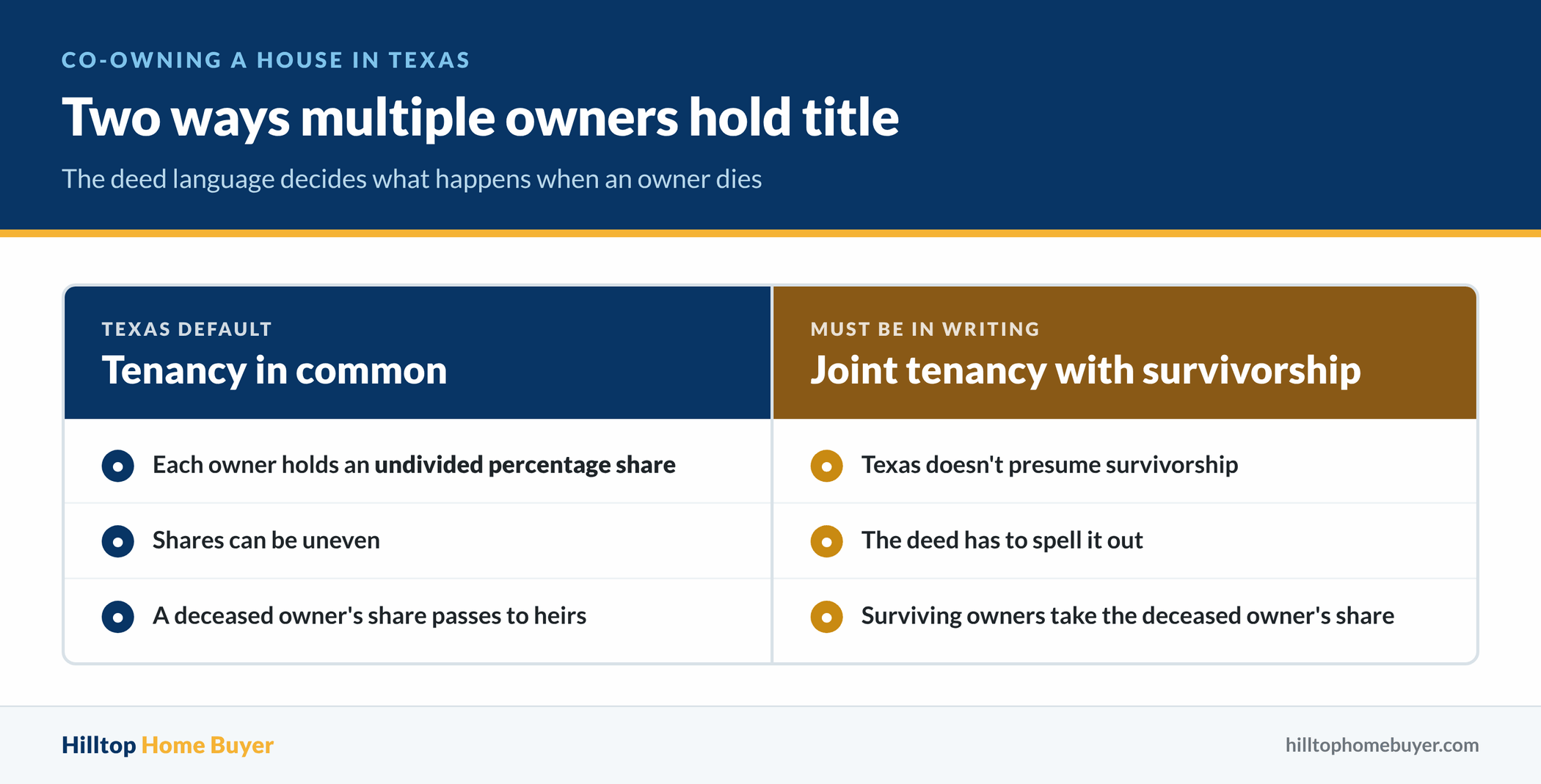
A few forms of co-ownership are recognized in Texas. Tenancy in common is the default here, and it means each person holds an undivided percentage share of the whole property. Joint tenancy with right of survivorship exists in Texas too, but it has to be spelled out in writing; our state doesn’t presume survivorship the way some others do. Without that language, a deceased co-owner’s share passes to heirs instead of to the surviving joint tenants.
Community property rules add another layer, since a house bought during a Texas marriage generally belongs to both spouses, even if only one name appears on the deed.
Where things get tangled is heirs’ property, where one death creates three owners, and when those three die, eleven more appear. I’ve looked at houses in East Texas where twenty-some people held interests, half of them unaware they owned anything.
So how do you find out who the multiple owners on a house really are? Pull the deed from the county clerk, then trace every death backward. An affidavit of heirship, signed by two disinterested witnesses, is a common Texas tool for documenting heirs without court. I’ve seen title companies lean on these heavily when a sale needs to move. After that affidavit has been on record for five years, Texas Estates Code §203.001 creates a presumption of heirship.
Multiple owners often discover a forgotten lien or an old mineral reservation at that stage, and it’s far cheaper to find it in week one than week six.
Does Inherited Property Have to Go Through Probate in Texas?
A family in Pflugerville called me convinced they’d need a year of court. They closed in under a month because their mother’s will qualified for a simplified probate procedure.
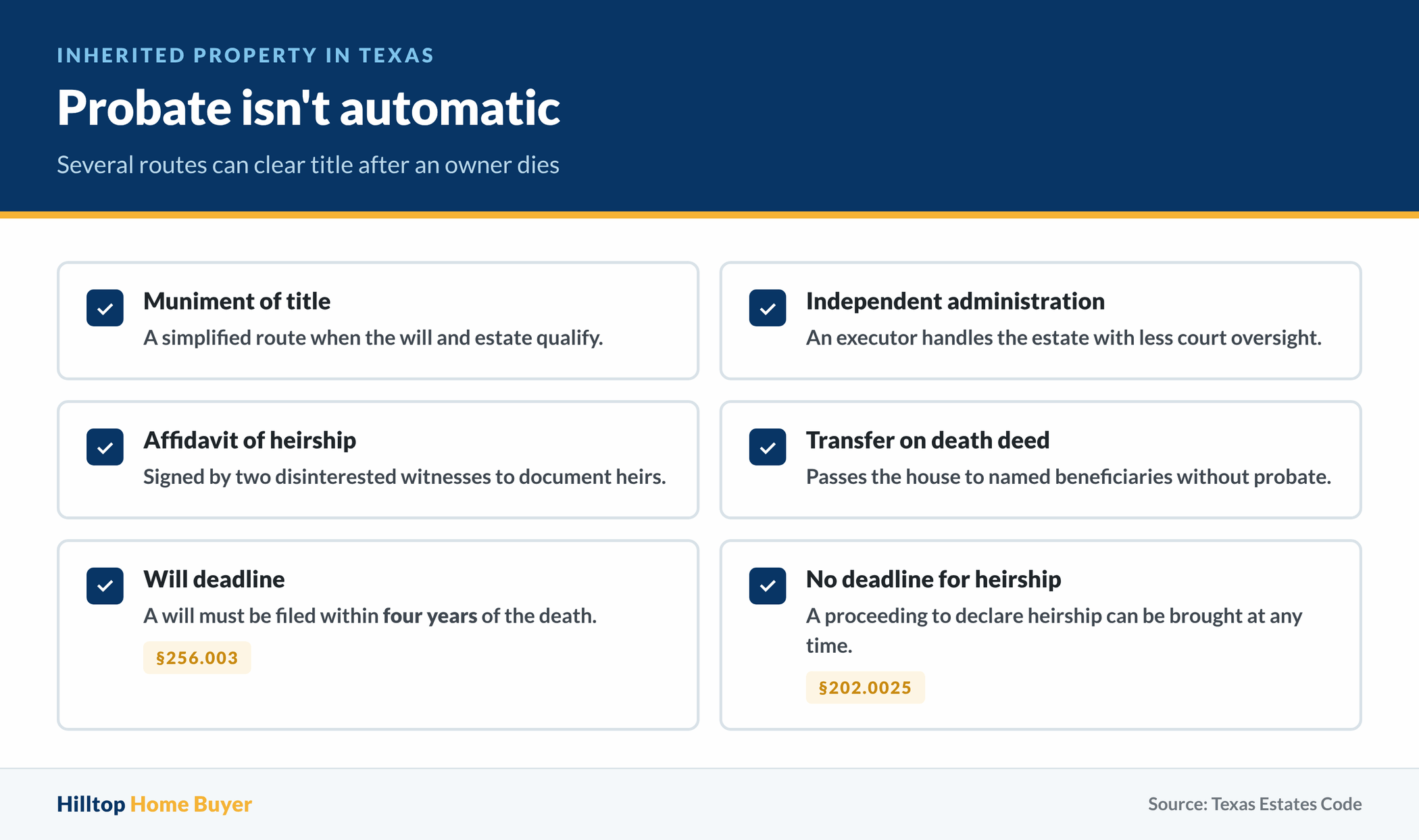
Probate isn’t automatic. Several routes exist in Texas to clear title after a death, and the heaviest one isn’t always required. The main pathways include muniment of title, independent administration, an affidavit of heirship, and survivorship through a transfer on death deed. For a clean estate with no debts and one house, that’s often all multiple owners need.
Keep an eye on the deadline. Under Texas Estates Code §256.003, a will must be filed for probate within four years of the date of death, and missing that window sharply limits an executor’s options. Your Texas probate attorney should confirm which route fits your estate.
Intestate estates run on a different clock. Under Texas Estates Code §202.0025, a proceeding to declare heirship can be brought at any time after the death, so families can sort it out decades later.
A while back I bought from a widow in Baytown who was three months behind on the mortgage with an auction date already circled on her kitchen calendar. Her husband’s name was still on the deed, and his two adult children from a first marriage were legal owners alongside her. We got an affidavit of heirship recorded, all three signed, and closed the Friday before the sale date, with her late husband’s fishing boat still parked in the garage.
Multiple owners should start the title work before they start arguing about price.
How Do You Sell a House with Multiple Owners in Texas?
The median Texas home sold for $330,000 in August 2026, according to the Texas Real Estate Research Center, and a number like that makes siblings pay attention. It also raises the stakes on getting the mechanics right.
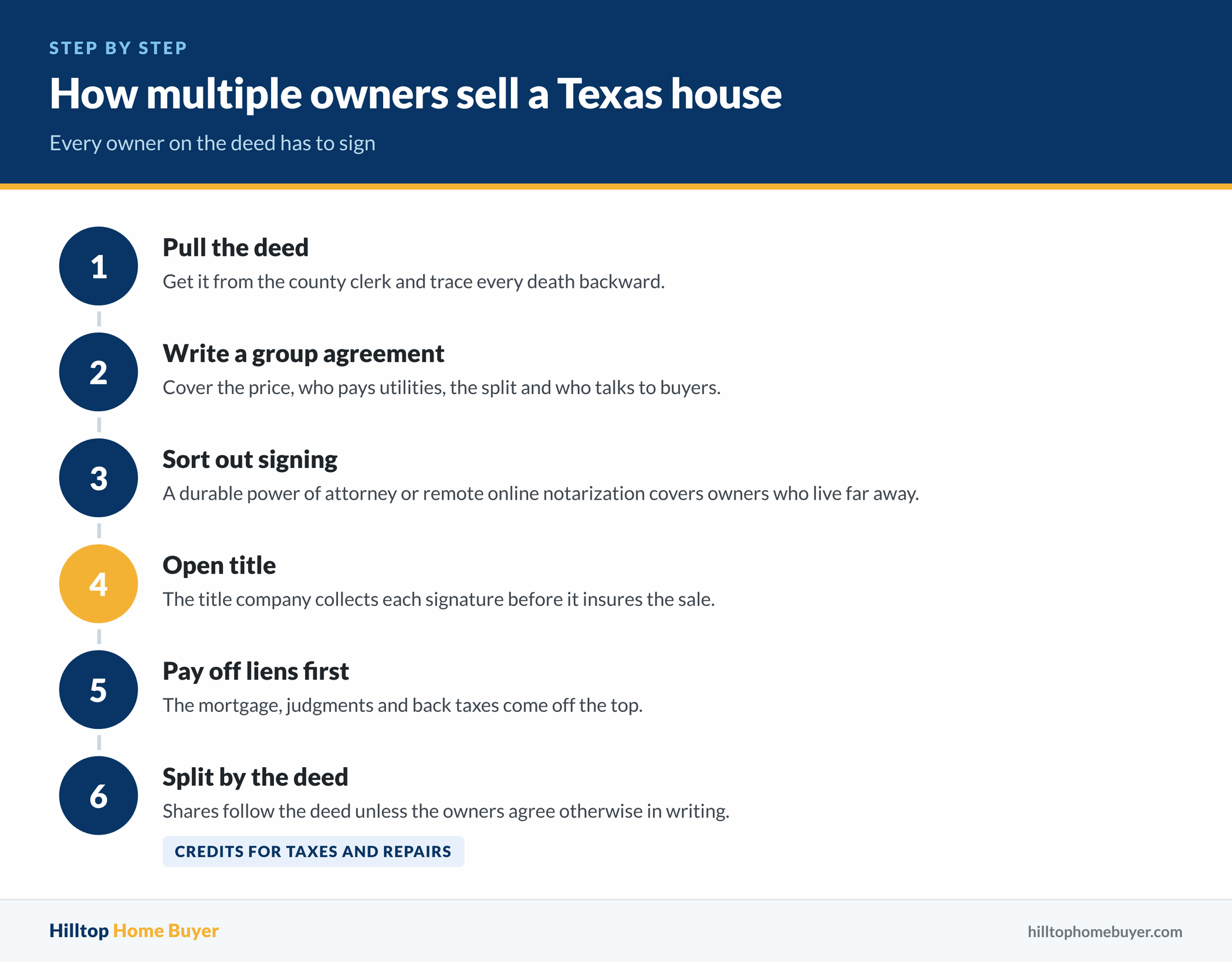
Every owner on the deed has to sign. That’s the short version of selling a house with multiple owners in Texas, and there’s no workaround at the closing table. A Texas title company will chase down each signature before it insures the transaction.
Start with a written agreement among yourselves. It doesn’t need to be a formal contract, just a signed memo covering the asking price, who pays the utilities until closing, how proceeds get split, and who’s authorized to talk to buyers. Multiple owners who skip this step end up renegotiating with each other every time an offer comes in.
One sibling in Lubbock, one in Atlanta, one in San Diego: a durable power of attorney lets a single person sign for the group, which means that’s the document worth sorting out first. Texas title companies will want to review and approve the form before closing, so send it over early.
Remote online notarization is legal in Texas, which has saved more than a few of my sales. An heir in another time zone can sign at ten at night.
Pricing is where multiple owners fight. One wants top dollar, one wants speed, one hasn’t seen the house since 2009 and thinks it’s worth what it was during the pandemic peak.
If your group wants certainty over maximum price, a direct cash sale skips the showings and the repair negotiations entirely. That’s the lane we work in at Hilltop Home Buyer, and we’ll tell you plainly when listing would net you more.
What Happens with Special Ownership Situations Like Divorce or Minors?
Family court decrees don’t automatically take an ex-spouse off the deed.
The decree can order a spouse to convey property, but the actual transfer happens through a recorded deed, usually a special warranty deed signed by the departing spouse. When they try to sell, the title company flags it, so suddenly an ex-spouse in another state has leverage over a closing.
Minor children make things harder for multiple owners. A child who inherits an interest in Texas real estate can’t sign a deed, and no parent can simply sign on the kid’s behalf. Courts generally require a guardianship of the estate or a court-authorized sale before that share transfers.
Life estates show up often in Texas farm and ranch families. One person holds the right to live there until death while the remaindermen hold the future interest.
Then there are owners who’ve lost capacity. If a co-owner has dementia, a valid power of attorney signed while they were competent is the easy path. Without one, a guardianship proceeding is usually the only route, and I’ve seen those drag on for months in most Texas counties.
Have you checked whether anyone on your deed falls into one of these buckets? Multiple owners routinely assume everyone can just sign, then discover a complication three weeks before closing.
If any co-owner has an active bankruptcy case, the trustee controls that person’s share, and the court has to approve the sale.
What If One Owner Won’t Agree to Sell the Property?
Three brothers owned a brick ranch house in Mesquite, and the youngest refused to sell.
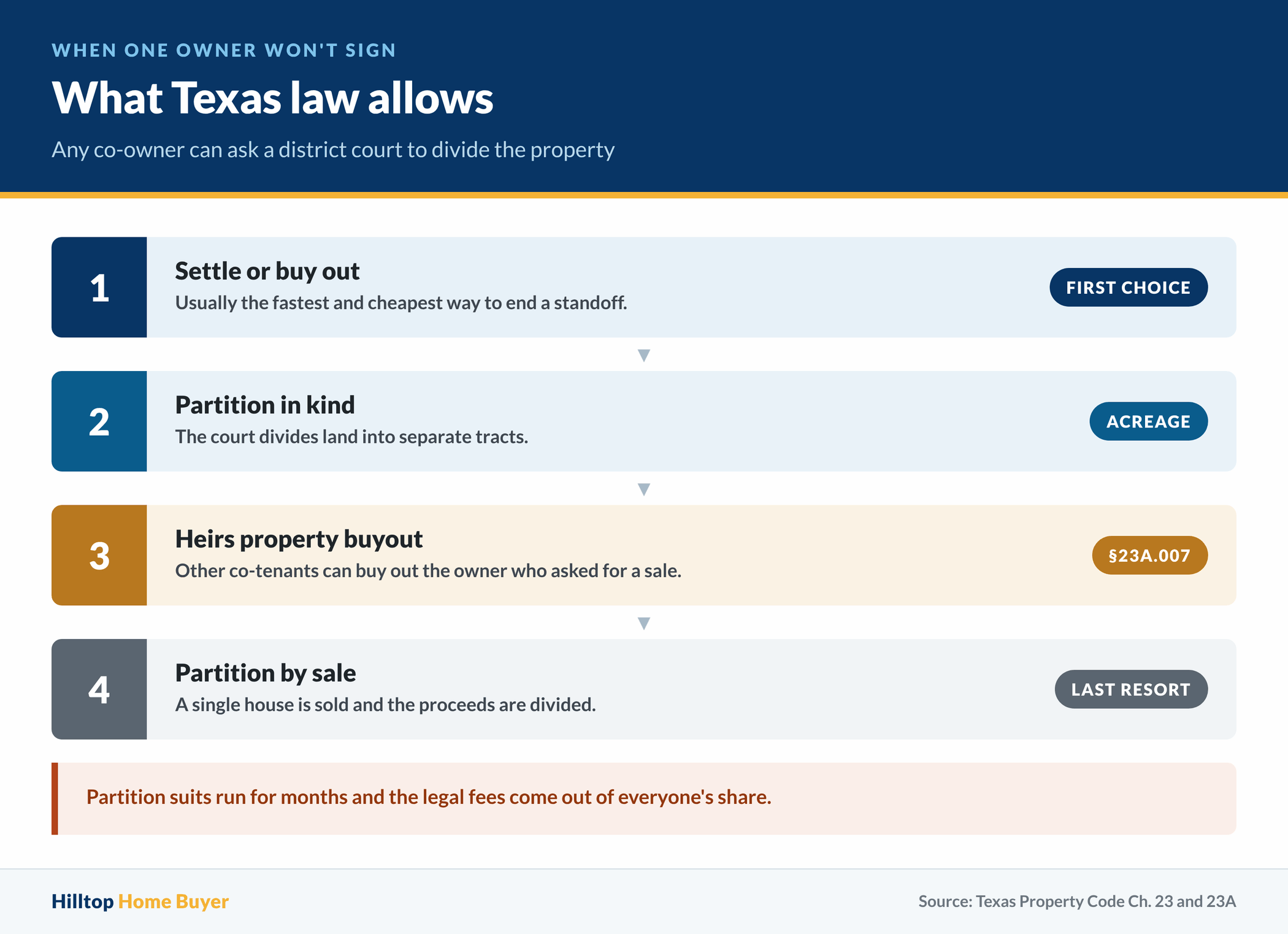
Under Texas Property Code Section 23.001, every joint owner or tenant in common has the right to compel a court-ordered division of the property. So if you co-own real estate in Texas, you generally have an absolute right to force a partition.
Two outcomes are possible. A partition in kind divides the property itself into separate tracts, so each owner ends up with a portion of the land. That works for acreage near Weatherford or a ranch outside Abilene. Most single-family houses can’t be split, so the court orders a partition by sale and divides the proceeds. Partition suits are filed in a district court in the county where any part of the property sits, under Section 23.002.
Inherited property gets extra protection in Texas. On September 1, 2017, Texas adopted the Uniform Partition of Heirs Property Act, codified in Texas Property Code Chapter 23A. Under Section 23A.007, when a co-tenant asks for a partition by sale of heirs property, the other co-tenants get the right to buy that interest at the court’s fair market value. So a forced sale isn’t the first option on the table, and the full rules are in Texas Property Code Chapter 23A.
Partition litigation runs months, burns legal fees, and poisons family relationships that outlast the house. I’ve watched multiple owners spend more on attorneys than the holdout’s share was worth.
When multiple owners are deadlocked, a buyout funded by a cash sale usually ends the standoff faster. The brothers in Mesquite settled when the youngest realized his share would cover a down payment somewhere else.
What Are the Biggest Challenges When Multiple Owners Sell a House?
Carrying costs are the quiet killer. Property taxes in Texas run high by national standards, insurance keeps climbing after our hailstorms, and a vacant house still needs the lawn cut and the AC running enough to keep mold out. Split four ways, those bills feel small. Across eight months, they’re not.
Timeline is the second challenge. Homes that sold across Texas in August 2026 spent an average of 65 days on the market, and the median seller price cut was $14,900. Add weeks for repairs and a month for closing, and multiple owners who list in spring can easily still be paying bills in the fall.
Repairs spark real fights. One owner wants to spend fifteen thousand on updates to chase a higher price. Unequal contributions during the holding period almost always resurface at closing, so write down who paid what from day one.
Pick one point of contact and put offers in writing. Give everyone the same documents at the same time.
Selling the house a parent built in Amarillo isn’t a spreadsheet exercise for the sibling who grew up in that back bedroom.
Statewide inventory sat at 5.3 months in August 2026, which gives Texas buyers room to wait. Softening prices punish indecision. When multiple owners dither for a season, the market can move against them.
How Do Multiple Owners Split Proceeds and Pay Taxes on a Sale?
“If there are four of us, do we each just get a quarter?”
Usually, but not always. Your deed controls the split unless the owners agree otherwise in writing. Tenants in common can hold uneven shares: one person at fifty percent, two at twenty-five.
Reimbursements change the arithmetic. A co-owner who paid the property taxes, covered the roof replacement, or made mortgage payments alone can claim credit against the other shares. Texas courts account for those contributions in partition cases, and title companies will honor a written agreement among the owners at closing.
Liens come off the top. The mortgage, any judgment liens, delinquent property taxes, and the seller’s share of closing costs all get paid before anyone’s check gets cut.
Taxes are where multiple owners get pleasant news. When you inherit real estate, its cost basis is typically adjusted to fair market value as of the original owner’s death. So capital gains tax generally applies only to appreciation that happens after you inherit. Siblings who sell within a year of a parent’s death frequently owe little or nothing. The IRS explains the mechanics of reporting a home sale and figuring basis on its own site.
The separate home sale exclusion only applies when the home was your primary residence for at least two of the five years before the sale.
Each owner reports their own share. One sibling’s rental use or capital loss doesn’t change another’s return. Get a CPA involved before closing, not in April.
Questions Multiple Owners Ask Before Selling a House in Texas
“A cash buyer will lowball us, so why would we even call one?” I hear that, and it’s a fair concern. My answer is that a direct offer is a data point you can compare against a listing, with no commission, no repairs, and no second showing. Run both numbers. If listing nets your group more after costs and three months of carrying expenses, list it.
Another common question: can one owner sell just their share? Legally yes, a co-owner can convey their undivided interest in Texas. Selling together is how multiple owners get full market value.
What about an owner who can’t be found? Texas has procedures for serving a missing co-owner by publication in a partition suit, but you’ll need a lawyer and a diligent search. Title companies in Texas won’t insure around a missing signature on their own.
Do all owners have to attend closing? No. State law allows separate signings, mail-away packages, and remote online notarization. I’ve closed sales where no two owners were in the same city.
Not long ago a seller in Round Rock was dividing assets in a divorce and wanted exactly one thing: the house handled without another conversation with her ex. Their attorneys agreed on the split, so we bought it as-is with the garage still full of his weight equipment, and the proceeds went straight to the two trust accounts. She told me afterward the sale was the only part of the divorce that didn’t require a hearing.
When multiple owners want a single closing date and no surprises, a direct sale earns its keep.
Frequently Asked Questions About Selling a House with Multiple Owners in Texas
Can My Sibling Block the Sale of Our Inherited Texas House?
Not permanently. Texas law gives any co-owner the right to ask a district court to divide or sell jointly owned property, even over another owner’s objection. For inherited property, the holdout’s co-owners also get a chance to buy out the filing party at an appraised value before a court forces a sale. Most families settle long before a judge rules.
What If One of the Multiple Owners Lives in the House and Won’t Pay Rent?
An occupying co-owner generally has the right to possess the property, since each person owns an undivided interest in the whole thing. That said, the other owners may have a claim for their share of fair rental value, and Texas courts can account for it when proceeds get divided. Settling that number in writing up front avoids a fight at closing.
Do All the Owners on Title Need to Sign the Texas Purchase Contract?
Yes, every person with a recorded ownership interest needs to sign the contract and the deed, or authorize someone else to sign through a power of attorney your title company approves. A missing signature stops a Texas closing cold. Figure out who’s on title before you accept an offer, not after.
How Long Does It Take Multiple Owners to Sell a House in Texas?
A clean co-owned sale where title is already clear can close in two to three weeks with a cash buyer, or a couple of months on the open market. Add time if probate hasn’t been completed, if a minor or incapacitated owner is involved, or if heirs need to be documented first. The title work, not the buyer, is usually what sets the pace.
Will Selling an Inherited Texas House Trigger a Big Tax Bill for Each Owner?
Often less than families fear, because each owner’s taxable gain is measured against the value at the date of death rather than what the original owner paid decades ago. If the house sells close to that value, the gain can be small or nonexistent. Every owner reports their own portion, so each of you should run it past a tax professional.
Can Multiple Owners Sell a Texas House That Still Has a Mortgage on It?
Absolutely. The loan payoff comes out of the sale proceeds at closing, and whatever remains gets divided among the owners according to their interests. An owner who has been covering the payments alone can claim credit for those contributions, provided the group documents it before closing.
If you’re co-owning a Texas house with family and you’re not sure what to do next, I’m happy to talk it through. We can look at your title situation, run the numbers against a traditional listing, and tell you honestly which direction makes more sense for your group. Reach out to Hilltop Home Buyer whenever you’re ready. No pressure, no obligation, and no hard feelings if you decide to list instead.